
We live in exciting times. As founders of Tools4Legal , we are inherently interested in what is happening in the legal services market. We strongly believe in sharing ideas, exploring new avenues of thought and learning through practice. Our White paper series, also available on the Tools4Legal website captures the essence of our research and experience, translating it into ideas and tools that we want to share with you.
In this first edition, we explore the general trends in the international legal market. Our study of over 200 new entrants and incumbents in the legal services market has enabled us to develop a new legal services matrix, which can be used as an analysis tool, which we call the Legal Innovation Matrix.
The Legal Innovation Matrix helps legal professionals make sense of what is happening today in the legal market. Law firms and lawyers can use it to better understand the challenges that lay ahead and the strategic options for change as well as the inevitable hurdles they may encounter. Companies, general counsels and company lawyers also can use the Legal Innovation Matrix to better understand the options currently available to them when looking for new ways of legal service delivery.
DISRUPTIVE INNOVATIONS AND PARADIGM SHIFTS
The legal market is evolving. Some might even be as bold as to say that it is being disrupted or on the brink of disruption.
On the supply side, it started with the early dawn of legal process outsourcing providers (socalled LPO) between 2000 and 2005.
Working as an outsourcing partner for law firms or directly with clients, typical LPO providers such as Integreon, Pangea 3, Quislex, etc., quickly captured market share and in doing so, created a new legal service delivery model. In parallel, we saw the birth of alternative law firm models, most successful in the example of Axiom legal (1998). The initial LPO shift was intensified by the 2007 financial crisis, closely followed by the introduction of alternative business structures under the 2007 Legal Services Act in the United Kingdom, the latter heralding a wave of new and innovative providers of legal services.
On the demand side, we saw a strong rise in the power of general counsel and a strong growth of in-house legal teams.
Concurrently, companies faced increasing pressure to be more efficient and reduce legal spend or were increasingly unwilling to spend money on what is no longer perceived as added value. These same issues still linger today.
Whether the market is being disrupted or not is – although a popular question these days – not the key issue. The prevailing law firm business model has worked for many decades and will most likely continue to work for years to come.The death of the billable hour ha been announced many times over. That does not mean that the market is not changing. It is. It is changing rather quickly. Understanding how the market is changing and why will determine whether providers of legal services and companies will be able to benefit from these changes. The Legal Innovation Matrix leads the way.
WHERE MARKET DEMAND MEETS MARKET SUPPLY: TODAY IT IS ALL ABOUT LABOUR COST ARBITRAGE.
The intersection between legal supply and legal demand is becoming ever more constrained, save for bet-the-firm-work exceptions. Hence, today most clients – and consequently also law firms – focus on reducing costs.
For clients this means procurement, price negotiations, alternative fee arrangements, using contract lawyers or alternative providers of legal services.
For law firms, this means alternative billing structures and reducing internal spend and cost structures. Clients take more work in-house. Law firms set up delivery centres and centralize support services. This is generally captured by the ‘more for less’ sound bite. The measures taken on both sides of the supply-demand spectrum are often based on labour cost arbitrage.
Put differently: Why pay a lawyer for what a professional support lawyer, or even indeed, a paralegal can do? Replace the words ‘professional support lawyer’ or ‘paralegal’ by the word ‘technology’ and you essentially captured Oxford University Fellows C. B. Frey and M. Osborne 2013 vision on the future of employment with regards to the legal market. Labour cost arbitrage is really only the beginning of the answer to today’s market dilemma and the search for new legal service delivery models.
THE IDEA EXPLAINED
Traditionally, a law firm would sit in the middle of the bull’s eye, combining aspects of all four quadrants (see next page). It will serve as a platform for the provision of legal services, valuing and monetizing on its people’s experience and expertise, whilst trying to capture that experience and expertise through knowledge management, combined with the smart use of technology. Our research shows that today’s market is disintegrating. New legal service providers are focussing increasingly on only one of the four quadrants.
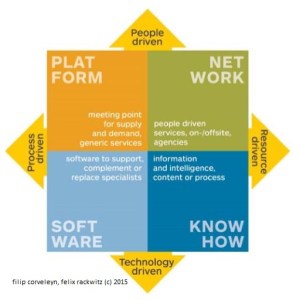
More traditional players will still combine one or more quadrants. Some exceptional players attempt a more ambidextrous approach (i.e. hedging against change by operating different business models, much like McKinsey did with McKinsey Solutions in 2007).
As always, examples explain best. Typical examples of platform providers could be Neulexa, Lawkick or the Ask-a-Lawyer section of the Rocket Lawyer website. These websites create a platform where legal clients and legal service providers meet.
Smartlaw, Tymetrix, Rocket Lawyer and LegalZoom, Flightright, New Street Solutions etc. are examples of legal service providers that focus on technology to forge new ways of legal service delivery.
Legal contract management systems, document building engines, e-discovery tools, legal data management tools, and quantitative legal prediction software are clear examples of such solutions.
Obelisk Legal Support, initiatives such as Berwin Leighton Paisner‘s lawyer’s on demand, Eversheds Agile, Allen & Overy’s Peerpoint, etc. are examples of service providers focusing on delivering network solutions. They are labour cost arbitrage solutions delivered through contract lawyers, lawyers on demand, managed legal services and on-thespot teams with a focus on providing added value through network power.
And finally, Thompson Reuters (with the inclusion of e.g. the Practical Law Company and the Hildebrandt Institute), Wolters Kluwer (and their recent acquisition of Smartlaw), Bloomberg Law, etc are mainly focused on managing, creating and delivering know-how and templates. They are however more and more combining know-how with software to create new legal solutions, balancing the thin line between being a supplier to law firms and a direct provider of legal services.
WHAT DOES IT SOLVE?
The key question – for both providers of legal services and buyers of legal services – still remains: Make or Buy?
For providers of legal services, the Legal Innovation Matrix provides additional insight into one’s relative position in the market. This in turn dictates the possibilities surrounding one’s value proposition and ultimately one’s profit formula – two of the four key elements of any business model – as outlined by Christensen et al. A good business strategy begins with focus. If more players are focusing on only one aspect, you need to know what your focus is or will be.
This in turn will impact your business model and hence pricing, sourcing and organisational structure, required support services, marketing, social media strategy, invest-ment decisions, complementary services, eco-system coop-eration and collaboration.
An example: it makes no sense to propose commoditized legal services if one operates in the Network zone at the right top corner of the quadrant – as here your selling proposition is based on providing top quality people resources and nothing else. This will ultimately drive your make or buy decisions.
For buyers of legal services, the Legal Innovation Matrix provides insight on whether you actually need to buy legal services and if so, what type of provider to choose depending on the actual business need. Firstly, it allows you to better identify the real nature of your legal requirements. Do I need people, software, knowhow, or a way to find legal service providers? What is the core essence of your legal query? Secondly, if you now know what you need, can you make it yourself (i.e. do you have the proper resources at hand) or should you buy it?
In case of the latter, you can now better focus your search for a provider of legal services. In our next Tools4Legal White Paper Issue, we will elaborate on each of these aspects.
THE REASONING BEHIND THE IDEA
The Legal Innovation Matrix is based on the idea that one should not look for the legal market disruptor or disruptors. Instead one should concentrate on understanding the drivers of change. In our view, there are two: the democratization of legal know-how and the introduction of modularity in the legal services industry (commonly labelled unbundling).
Firstly, modular design by its nature makes complexity more manageable as it allows for parallel work streams. More importantly though, it creates opportunities for innovation. In particular this relates to new legal skills such as project management, process management and process unbundling, decision tree and work flow management and knowledge of business process management.
Secondly, legal know-how is becoming increasingly more publicly available and is also available at lower costs to increasingly more people and businesses. Exponentially increasing computing power (Moore’s law) combined with the exponentially increasing possibility of storage of data (Kryder’s law) creates vast opportunities for further change in the legal service delivery model.
SOME FINAL THOUGHTS
Today’s economy is ever more driven by the high impact of uncertain events. Hence, a focus on agility and the consequences of uncertain events (black swans), rather than the probability of uncertain events, will ultimately deliver benefit.
In other words, one should not focus on one specific option, but create, transform or build one’s organisation in such a way as to be able to cope with change. This requires thorough understanding of one’s market. The Legal Innovation Matrix provides that initially required clarity.
AUTHORS
Felix Rackwitz (41) MBA (Cambridge), Managing Director and head of BD Tools4Legal; law firm management and global head of Business Development (15 years). Cambridge thesis on impact of innovations on law firms and lawyers.
Filip Corveleyn (37) MBA (Cambridge), Head of R&D Tools4Legal, former restructuring lawyer (12 years). Cambridge thesis on the impact of modularity on legal innovation/disruption
Tools4Legal is a Frankfurt based company, designing and building new ways to deliver legal services for corporations and law firms. We use design thinking, follow-me home techniques to fundamentally rethink the way in which legal as a product and service can be delivered to corporate clients. Why not contact us and learn about what we can do for you?
 The Legal Innovation Matrix